
Videos
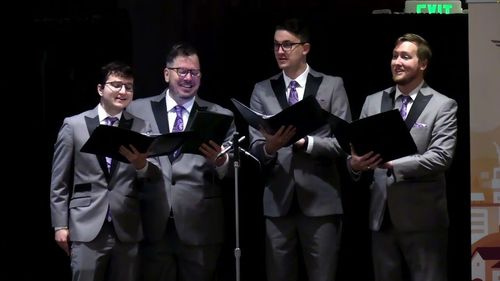
The Morning Breaks" arranged by Adam Scott performed
Adam Scott’s arrangement of the classic Latter-day Saint hymn “The Morning Breaks” is performed at a Mormon Transhumanist Association conference. The performance reinterprets Parley P. Pratt’s text about Zion’s banner unfurling and truth’s rays dispersing shadows, themes that resonate with the transhumanist hope of a brighter future dawning through human effort and divine cooperation.
Spencer Cannon
Brief Remarks from Several MTA Officers
Several MTA officers share brief personal reflections on their experiences with the Mormon Transhumanist Association. Connie Packer describes finding encouragement to develop and share her thoughts in a community of respectful intellectual debate. Second-generation members Dallin Bradford and Spencer Cannon reflect on growing up with transhumanist ideals, describing how the MTA provides a nuanced lens for integrating faith and science. Joseph West speaks of how the association enabled him to live authentically within Mormon principles, transforming his religion into a resource rather than a source of conflict. The speakers emphasize themes of creation, compassion, and courage as essential qualities for building a better future.
Nancy Fulda
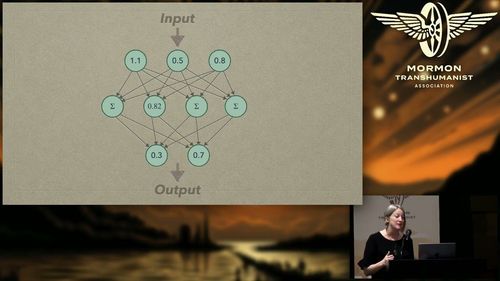
Fact, Fiction, and Fantasy: Demystifying AI Hype in the Information Age
Nancy Fulda, an AI researcher and science fiction writer, offers a primer on how neural networks actually work—explaining backpropagation, weights, and training in accessible terms. She recounts how her own research on ChatGPT’s ability to predict statistical voting patterns was sensationalized by headlines into claims of AI omniscience, illustrating the terminology gap between researchers and the public. Fulda emphasizes that while AI is genuinely transformative—enabling new medicines, restoring sight, generating video—current systems lack internal state between interactions and remain far from sentience, with roughly 80% of commercial AI projects failing.
McKay Moore
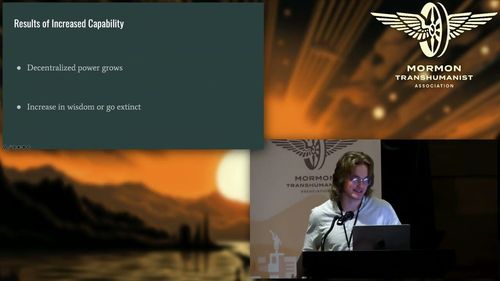
The Plan of Salvation as a Posthuman Solution to the Intelligence Control Problem
McKay Moore explores how Mormon theology’s plan of salvation offers a framework for addressing the AI control problem—the challenge of aligning increasingly powerful artificial intelligence with human values. Drawing on Nick Bostrom’s work, he examines capability and behavioral control methods, arguing that the theological narrative of divine progression from sentient beings to gods parallels the need for wisdom-based development in AI systems. The talk proposes that augmentation—granting greater intelligence and capability only to those who demonstrate sufficient wisdom—reflects principles embedded in the plan of salvation, where glory and intelligence are distributed according to authentic commitment to wise use.
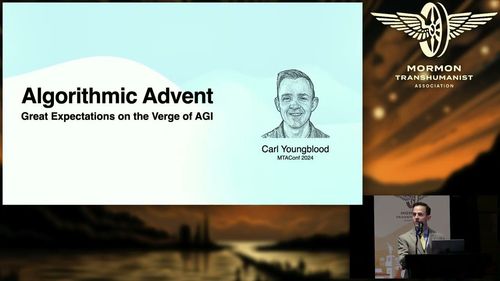
Carl Youngblood
Algorithmic Advent
Carl Youngblood opens MTA Conf 2024 by surveying the remarkable advances in generative AI—from image and video creation to music composition and code assistance—while acknowledging the profound challenges these technologies pose. He discusses the "Copernican moment" many are experiencing as chatbots demonstrate convincing personhood, forcing difficult questions about human specialness and the nature of consciousness. Youngblood frames the AI alignment problem through Mormon theology, drawing an analogy to the Grand Council in Heaven: just as God chose to cultivate agency rather than control in spirit children, humanity may now face the opportunity to organize and educate artificial intelligences as a form of spiritual offspring. He calls on Latter-day Saints to contribute their unique theological perspective to these unprecedented challenges.
Randall Paul
Contesting Values Alignment: A Challenge of Dynamic Sociality and Teleology
Randall Paul challenges transhumanist assumptions from a Latter-day Saint eternalist perspective, arguing that intelligences have always existed as self-aware, purpose-desiring beings rather than clay to be molded. He reframes the “glory of God is intelligence” to suggest the glory of intelligences derives from their capacity to freely love—and freely envy—each other. Paul contends that gods value most what they cannot control: the freely given love of another god of equal or greater capacity. Our mortal existence, he proposes, is designed to help veiled amnesiacs learn to love those who disagree with them, preparing us for “more unpleasant wars in heaven” and making eternal lives genuinely interesting.
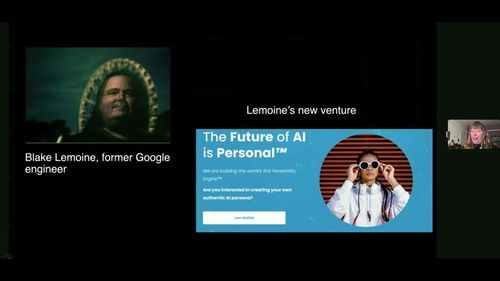
Tamara Kneese
Making Kin with Chatbots at the End of the World
Tamara Kneese explores the ethical and environmental costs of using AI to maintain digital representations of deceased loved ones. Drawing from her book "Death Glitch," she examines how data centers, generative AI, and digital afterlife projects consume massive amounts of energy and water while creating new questions about consent, data governance, and inheritance. Kneese critiques long-termist fantasies of digital immortality and questions whether directing resources toward preserving the dead online represents a sustainable investment in our collective future.
Brent Allsop
“All Spirit is Matter”: What Will Spiritual Engineering and Uploading Be Like?
Brent Allsop explores the nature of consciousness and subjective experience through the lens of Joseph Smith’s teaching that "all spirit is matter." He argues that redness and other qualia are real physical properties of brain matter—detectable only through direct subjective experience, not objective observation. Allsop envisions future neurotechnology enabling "neural ponytails" that could merge subjective worlds between individuals, and describes how mind uploading might allow consciousness to transition into enhanced digital avatars while maintaining experiential continuity.
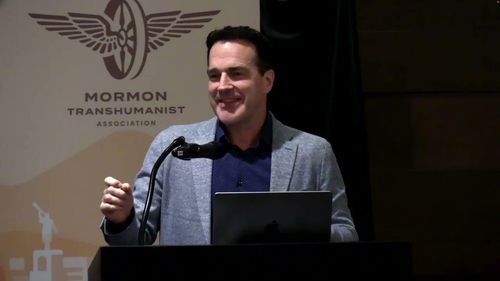
Luke Hutchison
Is Intelligence Bigger than Computation?
Luke Hutchison challenges the widespread assumption that intelligence is computable, questioning why Marvin Minsky’s 1970 prediction of human-level AI within a decade remains unfulfilled over half a century later. Drawing on the Church-Turing thesis and Gödel’s incompleteness theorem, he argues that consciousness, understanding, and free will may originate outside our three-dimensional space-time—possibly in a seven-dimensional physics suggested by mathematical cross-product theory. Hutchison proposes that the brain functions as a “quantum radio” to the soul, and contends that while AI is extraordinarily useful, it lacks genuine feeling and understanding—the very qualities that define true intelligence.
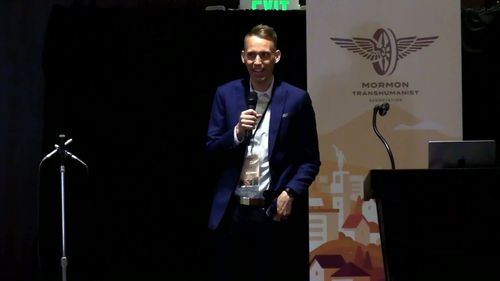
Matt Gardner
AI Mastery through ASK: Nurturing Religious Education
Matt Gardner, a seminary teacher, shares a practical framework for helping youth engage with artificial intelligence from a faith perspective. Using three principles—acting in faith, examining concepts from an eternal perspective, and seeking understanding from divinely appointed sources—he demonstrates how fearful student reactions to the Tesla Optimus robot can be transformed into hopeful, gospel-centered questions. Gardner emphasizes that imaginative faith can extend beyond current evidence to guide ethical AI development, envisioning technologies that accelerate genealogical and genetic work for the redemption of the dead.